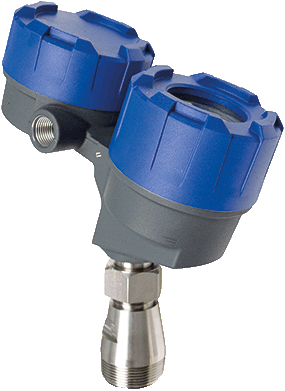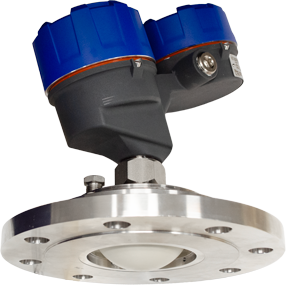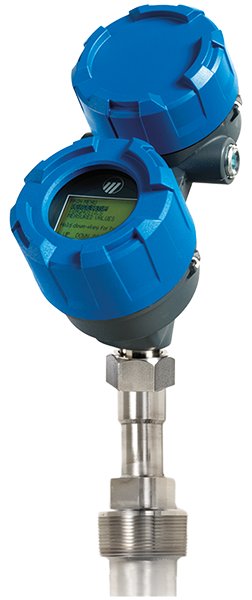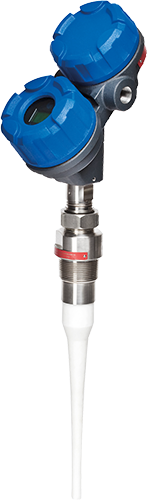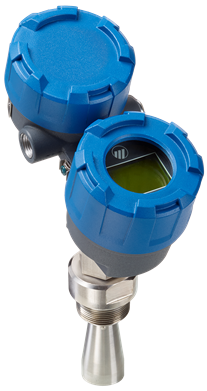
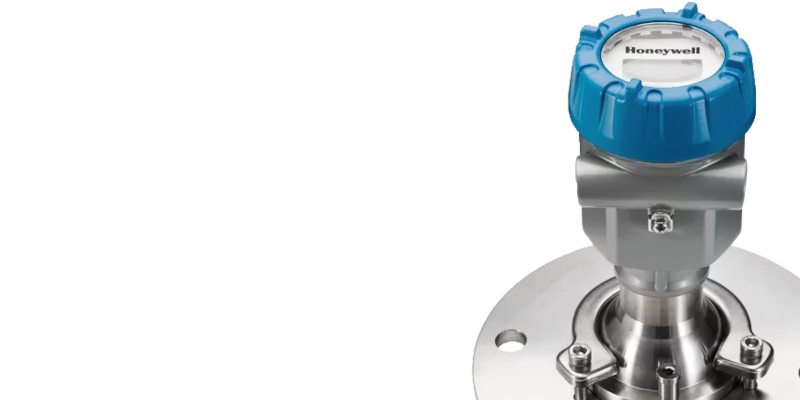

Pulsar® R80 is the latest non-contact level transmitter for liquids, including sanitary applications, and bulk solids. It uses frequency modulated continuous wave (FMCW) of 80 GHz. The high-frequency waveform provides greater accuracy and resolution, and allows to be antennas and process connections as small as 3/4 NPT.
CE
ATEX Ex d
ATEX Ex i
SIL 2
HART®
Pulsar® R80 is the latest model in the Magnetrol non-contact radar family. It uses a continuous 80 GHz frequency modulated (FMCW) microwave signal. The device has been designed on the recognized electronics platform previously used in the Eclipse® 706 GWR transmitters, Pulsar® R96 and Pulsar® R86 non-contact radars.
The Pulsar® R80 level transmitter is available with antennas designed for liquids, hygienic applications, and bulk solids materials. The bulk material antennas come standard with an adjustable mount for precise signal control and a purge port to clean the antenna. A particularly useful feature of the transmitter is the ability to remove the transmitter head without depressurizing the tank.
The use of the 80 GHz frequency for measuring the level results in a narrower beam of emitted waves - even 4°. The higher frequency also makes possible to use smaller antennas helping in installation of the device. An additional advantage is the circular polarization of the radar beam, which eliminates the need of difficult positioning antenna on the object in order to obtain the best signal reflection. As a conclusion - these features improve application versatility and allow for mounting in locations previously inaccessible to non-contact radars.
Pulsar® R80 firmware facilitates operation - configuration and solving problems that may arise in the process. The unique advantages of level transmitters include:
FMCW modulated wave radars use the energy of microwaves directed at the surface of the measured medium. The amount of reflected wave depends on the dielectric constant of the material. FMCW radars send the wave continuously and the frequency is constantly changing. For 80 GHz radar, the frequency of the transmitter can start at 79 GHz and go up to 81 GHz. The transmitter compares the frequency it receives from the surface of the product with the frequency it is sending out at the moment. The detected frequency difference between the transmitted signal and the returning echo is a function of distance. The level is calculated based on the height of the tank and other configuration information.
New generation Magnetrol radar level transmitters
High performance non-contact radar for continuous measurement of liquid level, volume or mass
details
New generation non-contact radar with 26 GHz signal frequency for continuous liquid level or volume measurement.
details
New generation, high performance Guided Wave Radar with increased signal strength, for most demanding applications
details